


Target audience
The tool is aimed at researchers, but could also be used by policy makers and health promoters at various municipalities, public health departments, teachers at educational institutions and practitioners.
Description
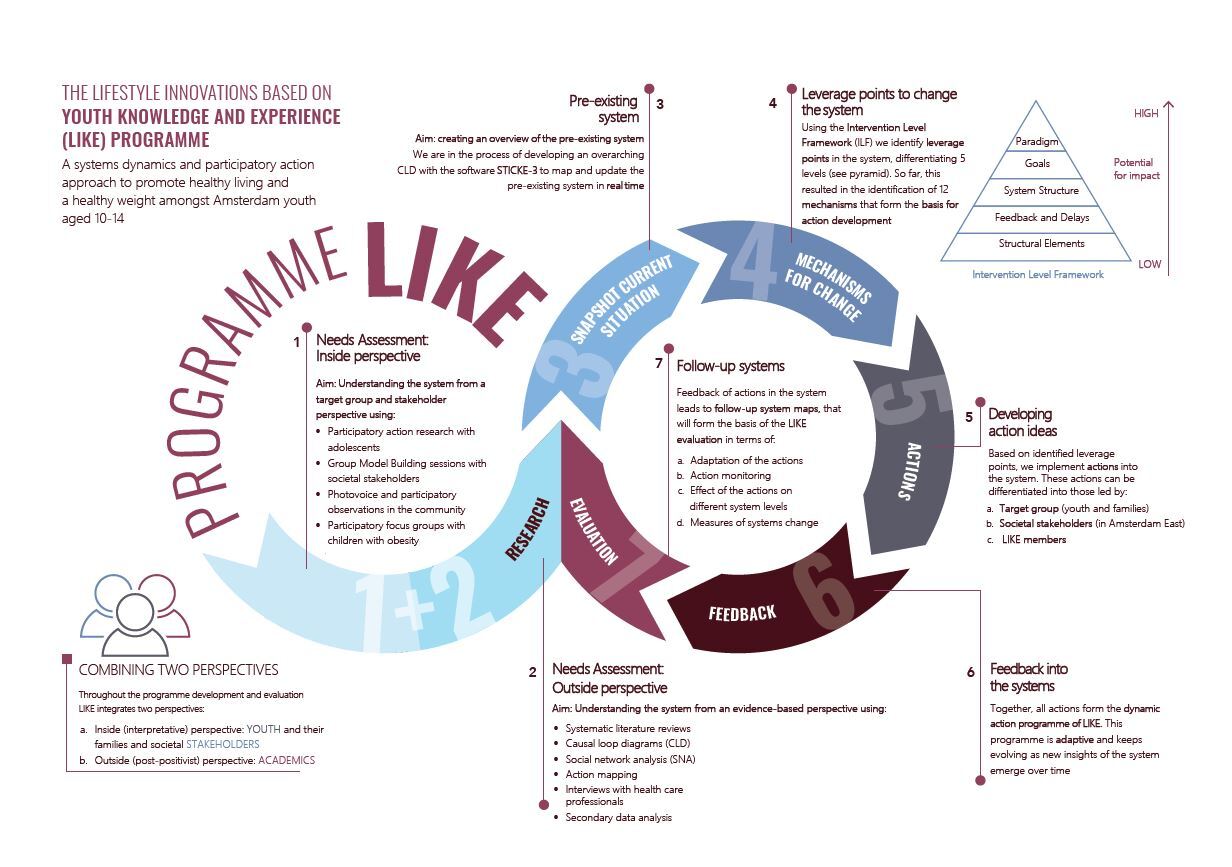
The figure below is a representation of the LIKE logic model (logic model). This model is deliberately shaped like the infinity symbol to show that a participatory systems approach is continuous and adaptive. The LIKE logic model consists of 7 steps. For each step, we have developed materials and tools to help understand, change and evaluate the system.
General information
As explained above, the LIKE logic model provides an overview of LIKE as a whole. We have developed materials and tools for each of the 7 steps; building in part on other (international) research. The various steps and associated tools can be used separately, however, the underlying idea of LIKE is to use the model as a whole. For more information on this approach, see this scientific publication (System dynamics and PAR approach – Waterlander et al., 2020)
Important here is to get an idea of what we mean by systems thinking. For this, we created an animation:
We will explain each step in the following tabs and refer to related tools and articles.
Step 1 & 2: Needs Assessment
The first step in our participatory systems approach was to map the system (Needs Assessment) from different perspectives. In the LIKE study, we did this with the young people themselves, as well as other key stakeholders in Amsterdam East and the researchers in the consortium.
Needs assessment – perspectives of stakeholders & youth:
- Group Model Building is a participatory, qualitative method for identifying perspectives of different stakeholders around a given complex problem. For more information, read the Group Model Building Manual (In Dutch only). [Applying system dynamics methods for local obesity prevention: results from a group model building study in Amsterdam]
- Co-creation is a form of collaboration that leads to a final product where all stakeholders have an influence on the process and outcome. For more information, read the co-creation inspiration guide.
- Photovoice is a participatory action research method in which participants work as photographers themselves based on an assignment. For more information, read the [link follows].
Needs assessment – researchers’ perspectives:
- In the LIKE study, we also used scientific information to map the “outside” perspective. For more on this, read the article [Understanding obesity-related behaviors in youth from a systems dynamics perspective: The use of causal loop diagrams – Waterlander et al., 2021]
- Social network analysis is a method for understanding key actors in relation to a particular issue.
- Action mapping – action mapping can help map existing actions (and new actions). For more information, see step 4 in the ENCOMPASS framework via the [ENCOMPASS tool] and the scientific article [The ENCOMPASS Framework: A Practical Guide for the Evaluation of Public Health Programs in Complex Adaptive Systems – Luna Pinzon et al., 2022].
- Interviews with healthcare professionals – for more information see the scientific article [Perspectives of healthcare professionals on facilitators, barriers and needs in children with obesity and their parents in achieving a healthier lifestyle – de Pooter et al., 2022].
Step 3: Map the pre-existing system
At this step, it is important to map the system in the form of a causal loop diagram (CLD). The tools from steps 1 & 2 help to create the CLD and this can vary (e.g., through literature, Group Model Building, interviews, etc.). In LIKE, we combined the information from the methods named in steps 1 & 2 into an overarching system map or visualization of the system. For more information, read the scientific article[Understanding the system dynamics of obesity-related behaviors in 10- to 14-year-old adolescents in Amsterdam from a multi-actor perspective – Luna Pinzon et al., 2023].
There are tools to draw the map itself. In LIKE, we used the following tools to draw the system maps, such as STICK-E or KUMU.
Step 4: Mechanisms for change (identifying leverage points)
Once the system is mapped, “leverage points” or points of leverage can be identified to change the system (for more on this, see step 3 of the ENCOMPASS framework). An important insight here is to look for opportunities in different levels of the system namely:
- system elements (the individual puzzle pieces in the system, for example, a healthy school cafeteria)
- system structure (e.g. networks in the system, such as network between school, parents and supermarket)
- system goals (e.g., including health in governmental policies)
- paradigm (e.g., that the system is committed to health promotion over economic growth)
In LIKE, we used two methods to identify points of leverage: (1) the youth themselves (in PAR groups) (2) through groups with researchers, policy staff and professionals.
Read the scientific publication on this here
Multiple models are available to identify leverage points:
Step 5: Develop actions
Based on the identified leverage points, we developed actions that could change the system. It is also possible to modify existing interventions to better address the identified leverage points.
Read the scientific publication on this here.
Step 6 & 7: Feedback (monitor and adapt) & Evaluation
A program in a complex adaptive system also requires a different method of evaluation, which should take complexity into account. The ENCOMPASS evaluation framework was specifically developed for this purpose. The framework consists of five phases.
- Adopt a system-dynamic perspective in overall evaluation design
- Define the system boundaries
- Develop an understanding of the existing system to inform system change
- Monitor dynamic program output at different system levels
- Measure program outcomes and impact in terms of systemic change
For more information, read the scientific article[The ENCOMPASS framework: a practical guide for the evaluation of public health programs in complex adaptive systems – Luna Pinzon et al., 2022]
To better understand the steps, we also developed a tool [ENCOMPASS tool].